Sunday, 30 August 2009

The World Aerobatic Championship 2009

This week I found myself in an enviable position. The company I work for was one of the sponsors of The World Aerobatic Championship being held at Silverstone and I got the chance to work behind the scenes and enjoy corporate hospitality.

On Thursday I was on-site helping support the IT infrastructure for Flying Aces, the organisers of WAC 2009. The IT equipment for timing, TV and general office work had been set up by Ben and James earlier in the week and it was just a matter of jumping in when something went wrong. This left plenty of time for watching the flying and even to have a flight in the Q liveried SBACH 342.

Our pilot Andy took me through some 'gentle' aerobatics - absolutely awesome! I even got the chance to fly for a while - really very different to my usual PA28. I climbed at my usual rate and Andy kept telling me to pull the nose up until I felt like we would fall out of the sky! Silly of course since I later saw this plane climb vertically (as did all of the others). The ten minute flight over the Northamptonshire countryside seemed so short.


From WAC 2009


More photos under the WAC 2009 link including lots of competitor aircraft on the ground and in the huge tent hangers.

Friday saw the corporate day. I was feeling quite at home as the Ultimate High chaps from Kemble were taking our important visitors for flights.

Thursday, 18 December 2008

Flying the Circuit

When I arrived at the airfield on Sunday everyone was in a very friendly Christmas mood, mince pies and chocolates galore! Not so good on the flying front though, what had been clear in the morning had turned into a solid layer of grey cloud down at 1000 feet. It wasn't looking good until Stu suggested we try my hand at flying the circuit, meaning we would fly just below the cloud. An extensive brief followed, with detailed intructions for flying from runway 26 and into a left hand circuit. This was a familiar approach for me since we've always used 26. A shame then when we came to take-off we were instructed to use runway 08 and fly the circuit on the opposite side! Stu let me handle the take-off - I really shouldn't stamp on those peddles so hard though. I also did one of the touches - again too hard!

So the briefing went a bit like this. Stu said he'd handle most of the RT and the checks, so all I had to do was fly. I have to say it was probably my favourite lesson so far!

From flyian


• RT - “Kemble Information. Golf-Bravo-November-November-Tango”
• RT - “G-BNNT. Pass your message.”
• RT - “G-NT, PA28, tower apron, two POB, flying the circuit, request airfield information and taxi”
• RT - “X” (hold at Bravo 1)
• RT - “G-NT Alpha-1 ready for departure”
• Runway checks, transponder to ALT / DI and compass / T’s & P’s / check heading matches runway.
• RT - “G-NT Hold” / “Line up and wait” / “take off at your discretion”
• RT - “G-NT taking off”
• Full power
• Instrument check / power 2000/2500 airspeed increasing
• Centre line, choosing aiming point off runway
• 60 knots & rotate
• Nose to horizon giving 75 knots in PA28
• At 300ft AGL after take-off checks – T’s & P’s, flaps clean, (gear up), trim 75kts
• Bank 15˚, climbing turn, look right in LH circuit first
• Select aiming point.
• Wind from right
• Turn (30˚?) and new aiming point – Ashton Keynes lakes
• At 950ft start to level (10% of rate of climb)
• RT - “G-NT downwind for touch and go” or “to land”
• RT - or “G-NT downwind for late touch and go” if radio busy
• Downwind checks BUM FFI LCHH which should memorise [B.U.M.F.F.I.C.H.L. - Brakes, Undcrge, Mxtr, Fuel, Flaps, Instmnts, Carb heat, Hrness, Lights]
• Wingtip on the runway for correct 1-1.5 mile gap
• 45˚ from threshold, thinking about turning
• Descent called Base Descent
• Power 1700 RPM / Carb heat on / nose up / trim 75kts /
• Reduce speed to Vfe / 2 stages of flap
• 500ft/min descent rate ideal – manage height to be on glide path
• Turn final
• Centre line with rudder, aileron & wings level
• 3 stage flaps / 65kts
• RT - “G-NT final for touch and go” or “final to land”
• Runway number as aiming point
• Judge the flare

Saturday, 29 November 2008

Foggy November Morning

To get back into the swing of things I thought I'd book a lesson this weekend. I'd been watching the weather forecast all week and it really didn't look good. This morning was as promised - as foggy as you like. I drove over to Kemble anyway - just to say hello, check the journey from the new house and persuade myself to get on with flying. I met up with Stu who filled my in on all of the gossip. We chatted for while with Tom who had come to replace brake disks and pads on one of the club's leased PA28s - interesting chap. A splendid bacon sandwich in AV8 (thanks mate!) and a view of the club's Granville trip DVD and I was on my way home. Another lesson booked for two weekends time.

Tuesday, 9 September 2008

Rainy Weekend Stalls

Well much to my surprise conditions were good enough on Sunday to fly. The pressure had been rising all day, the cloud lifted until we had over 2000ft to play with. This Sunday I was learning slow flight, including standard stall recovery.

I should really have written this up straight away. Damn my shabby memory.

Every manoeuvre seems to have its own work process acronym - this one was no different. HASELL stands for

H - height. Do we have enough for this? 3000ft is the recommendation.
A - aircraft. This is our plane. Is it configured, in trim, straight and level.
S - security. Physical security for passengers, pilot and loose articles.
E - engine. Temperatures and pressures.
L - location. Are we in a suitable place. ABCCCD (Airfields, built up areas, crowd, cloud, controlled airspace, danger areas)
L - lookout. Is the airspace clear and safe. We should include some turns to clear.

On subsequent trys we can reduce this to HELL.

We start with

P - power - 1500 RPM and in balence
A - attitude - > 60kts, 2000 RPM
T - trim

Standard Stall recovery (At Last)

So the aircraft stalls when the angle of attack is around 15˚ - not very steep. This is known as the critical angle. To recover:-

Pitch forward
Apply full power
Balance

I felt okay doing the stall recovery - seemed fairly sensible. However I didn't get to see what happens if one wing drops - one should keep the ailerons straight. Doing otherwise makes things worse - spinny spinny! Stu demonstrated a spin recovery which once again had my stomach in my mouth.

Monday, 1 September 2008

Kemble Information

Well things looked good this weekend when I left home, but as I got closer to Kemble the cloud gathered. When I entered the club house (in their own words) six grown men were gathered looking at the sky. One of them was my instructor Stuart who sadly told me the cloud was too low and too solid to do slow flight and stalls for which we needed plenty of altitude. I hung around for a little while to see what would happen - the weather was right on the edge of clearing up, but I was to have no flying today.

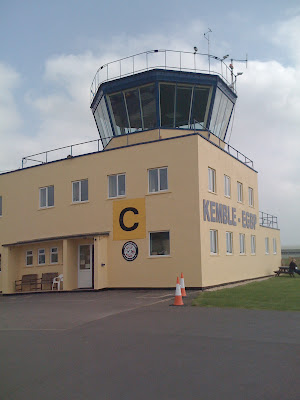
So Stu took me for a tour of Kemble Operations and the Control Tower. Glenn was running things in the tower and it was fascinating to see how things worked from this side. Each aircraft has a card and plastic holder which Glenn was putting in different places on a special rack to indicate where it was - on the runway, taxiing, circuits, flying in the local area or passing through. Things looked quite complicated and he was only looking after six aircraft. One cheery thing though was just how many people got RT stuff wrong - there's hope for me yet. The aviation world was firmly divided into newbies getting RT wrong and sounding nervous and those real old hands who confidently got things wrong or were simply unclear. Stu explained the importance of keeping the messages short and accurate - the tower has a lot of people to deal with and one shouldn't hog air time.


I was happy to see the return of Zulu Whiskey to the club after weeks being away for repair. She'd only arrived the day before and apparently Zoe was seen to do a little dance. Zulu Whiskey has been away for months for service and was waiting for parts from the States. It was also nice to see one of the Piper Cubs I'd seen at Duxford in July at Kemble today. She was refueling while we were in the tower but sadly I missed the takeoff. All of this just serves to fire my enthusiasm and I just want to fly. I'm sitting here with rain lashing against the window yet again this summer.

Sunday, 24 August 2008

Lookout!

I picked an early morning lesson this week - the weather forecast wasn't so good later in the day. In the briefing and cup of tea beforehand we discussed the previous lesson (climbing and descending) along with today's lesson 9a - medium level turns. Stuart touched on Ve and Vne which are rapid descents used in an emergency for cabin and engine fires respectively. Medium level turns covered turning at 30º. The workflow for this was lookout, attitude, instruments. Lookout is a big lookout from tail to tail - all the way round. Attitude includes keeping the nose up since the tendency is to descend and to keep the turn angle consistent. For instuments we cycle through the artificial horizon, altimeter, balence ball, directional indicator and vertical speed indicator.

Stu got me to A-Check my PA28 G-PSRT. For some reason I have a soft spot for Romeo Tango and was happy to. I must get a better handle on this long check though!

The flight itself was fantastic! A very clear day with a few blobs of cloud at around 3000ft. Stuart demonstrated the Vne descent - OMG! Definately the most dramatic ride I've ever had in an aircraft. The idea is to blow out any engine fire and we decended 2000 feet in what felt like 10 seconds with sideslip and nose down. Stu then asked me if I wanted to try the manouver - I think we'll leave that until I have a little more confidence.

Next came mid level turns. I wasn't too bad, a bit slow leaving the turn. The target should be 15º before the target and as usual so much to think about. Several times though I missed the Lookout at the start of the manouver. Most important considering the crash at Coventry this week.

Finally we flew back to Kemble. I flew the approach, final turn and Stu made the landing. It was a shame the lesson seemed so short!

Lots of radio work for me this week, including various acknowledgements repeating the airport information back to the control tower.

Still so much to learn!

Monday, 11 August 2008

Sunny Weekend

Well another fine British summer weekend meant no flying this weekend. So I thought I'd post a few pix from my trip to the aviation museum at Duxford in July. I wish I'd had more time to watch everything that was going on, I'll just have to go back. Here are one or two of my absolute favourites. I'd love to fly any of these!


Duxford

Monday, 4 August 2008

Climbing, Descending, Descending and Climbing

British summer must be over. I had two lessons this weekend making four in seven days without bad weather. This week's lessons were both in PA28s. G-AXZF is a PA28-180E and G-BFDK is a PA28-161. The flying club's C152's are still unavailable, but I'm liking the PA28s more and more.


Saturday started cloudy but cleared to scattered cloud by the time my lesson came. I taxied and did the takeoff which I think was worse than my first. The lesson covered climbing and descending. Climbing is once again Power, Attitude and Trim as with increasing power in straight and level flight, but today we have Stuart's own acronym - DABLE that is Direction, Attitude, Balance, Lookout and Engine. Direction - are we heading for our reference point; Attitude - does the aircraft have the right attitude and therefore speed; Balance - is the aircraft yawing; Lookout - are we away from trouble. Remembering of course that we use full power for the climb and set carburettor heat to cold. Every 500ft or so we check for other aircraft by making clearing turns. Finally we anticipate reaching our chosen altitude by 10% of the climb rate and level off with APT. So much to remember.

Then we set about the gliding descent. Once again we see PAT in action. This involves reducing the power to the engine, setting the correct pitch to glide and trimming out the forces. Carburettor heat is of course hot for this and we warmed the engine every thousand feet.

Golf Zulu Foxtrot is a PA28-180E - by far the most powerful aircraft I've flown. I really noticed just how quickly we arrived at my normal reference points and just how quickly we got back to Kemble! It may have been a function of the head winds, but we were climbing at over a hundred knots.

Sunday's weather looked more shaky. The day got cloudier and darker. Zoe from the flying club called - there was an opportunity to have an earlier lesson since Stu had had some cancellations. Dashing to the airfield the weather picked up as I got closer - all was well! A couple of botched radio calls for me, followed by a heavy footed take-off left me feeling a bit low.

We ran over yesterday's lesson quickly. Then on to climbing with flaps, descending with flaps and we touched on side slipping with crossed controls to descend more quickly. Flaps are used in a climb to increase lift and usually used to shorten take-off though we forgot to deploy this time!

More complicated was the gliding descent with flaps. This is used on final approach and landing. The flaps increase drag, slowing us down and provide more lift which allows us to floy more slowly. We did some practice aiming for fields to demonstrate approach angles and heights. I think I see my own landings in the distant future! I was rather heavy handed with the controls today - another habit to break. The important lesson, Stuart tells me, is that power controls ascent and attitude controls speed.

I'm not sure I enjoyed these lessons quite so much. I seemed to be a bit poor on everything I tried - possibly because I was feeling a bit under the weather. I really hope for some improvement next week.